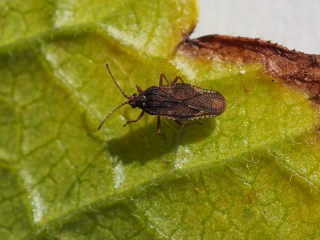
Another Lacebug.

There is an old hawthorn hedgerow beyond the blast shelter in the quarry and it is covered with lichen. I will happily leave identification of lichen to others, but there is a rather beautiful insect that lives in lichen growing on old hawthorn. It is one of the Lacebugs but is much darker than the frequently seen spear-thistle lacebug, it is a very narrow species and is only 3mm long … but is definitely worth seeking out. If you should find it, you will be looking at Physatocheila dumetorum.
 

2le54jq

A Positive Item About Ragwort

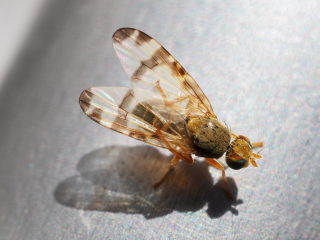
Ragwort gets a lot of bad publicity, and a lot of time and expense is dedicated to its control. There is no doubt that it can pose a threat to livestock if it is incorporated into hay as the wilting process makes some nasty alkaloids available in livestock feed, but there is also a positive side to Ragwort that garners fewer news reports. Many people have seen the yellow and black striped caterpillars of the Cinnabar moth feeding on Ragwort, but how many have seen the Ragwort Fly Sphenella marginata? It is one of the tephritid flies, a type of picture-winged fly, and its larvae form galls on Ragwort. Other species of tephritid fly have been seen regularly on thistle in the quarry and other areas of the Country Park, but this is the first time the Ragwort Fly has been found here. It is heartening to think that the ever-present Ragwort is helping to increase biodiversity in the Country Park.

Sphenella marginata

A Very Unusual Wasp

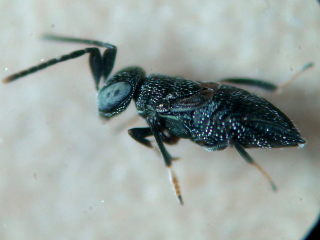
A look through the Rush flowering in the seasonal pond of the quarry produced an unexpected result recently. A flightless species of parasitic wasp, less than 2mm long, that moves around by jumping. It parasitises scale insects and other very small bugs. Close inspection showed it to be a metallic blue/black colour, and very difficult to see. Its antennae have a distinctive flattened section that fits into a groove atop its head if needs be. In some cases a single egg of this family of parasitoids can give rise to several thousand larvae, and the egg retains a stalk that protrudes from its host to allow air to the young larva. There are very few records of this native species, and this is a first for the Country Park.

Dinocarsis hemiptera

A Small Visitor.

The area of the quarry that was so expertly cleared by the conservation volunteers a couple of years ago received an inspection this week from an illustrious visitor. A shieldbug flew over from France in order to spend some time in this desirable location, and in so doing notched up a county first record for the species and the Country Park. Carpocoris purpureipennis is a shieldbug that occurs in France but has only ever been recorded in the UK on one or two occasions in the past. It is somewhat larger than the Sloe Bug although overall colouration is similar, but it cannot be mistaken for that native species. A very distinctive and very welcome discovery.

OLYMPUS DIGITAL CAMERA

Another New Record.

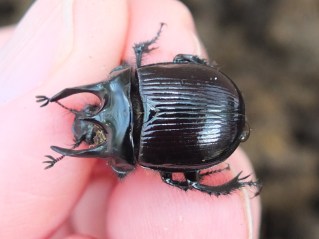
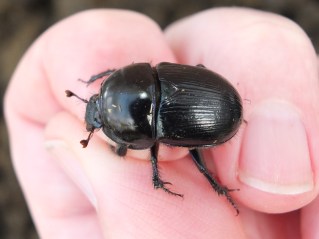
Further investigation of the dung beetles that live in ecosystems created by grazing in the Country Park has produced exciting results. There is a very healthy population of Minotaur Beetles Typhaeus typhoeus in the higher areas of the grazed fields above Warren Glen. This could be because of the very short-cropped grass with areas of poaching that exposes sandy soil allowing ease of burrowing. Turning over piles of dung revealed burrow holes that are typical of geotrupid beetles, and a little rummaging found many Minotaurs. Even better than that was the discovery of a Violet Dor beetle Geotrupes mutator in one of the piles of dung. This is a Nationally Scarce species that is almost unrecorded in the south-east, another good record for the Country Park. This brings the number of dung beetle species in the Country Park to seventeen (so far).

Minotaur                 Typhaeus typhoeusGeotrupes mutator

Mind where you tread (continued)

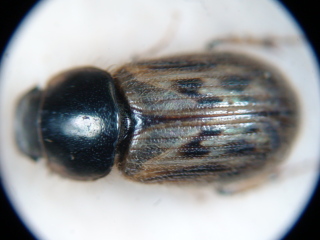
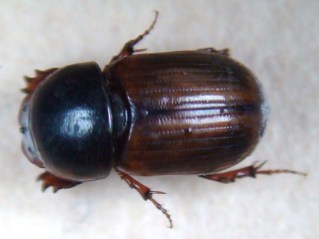
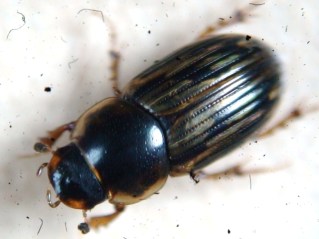
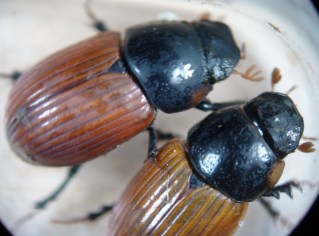
Another dung beetling session in the grazed areas at the head of Warren Glen found seven species of dung beetle, of which three were new to the CP. This bring the total to fifteen species of dung beetle thus far. The new ones were:

Aphodius (Nimbus) contaminatus (upper picture),

Aphodius (Planolinus) borealis (middle picture),

Aphodius (Volinus) sticticus (lower picture).

A.sticticus has been found in Guestling Woods and Battle Great Wood, but A.contaminatus and A.borealis would seem to be new to this area.

Aphodius contaminatusAphodius borealisAphodius sticticus

Mind where you tread.

It is now two years since the Exmoor ponies arrived as residents of the CP, to be joined by the White Parks and then the Belted Galloways. It is easy to see the effect that their residency and grazing is having in various areas above Warren Glen, but a less visible benefit is doing remarkably well. The output from their grazing has provided a welcome opportunity for Dung Beetles to enrich the insect fauna of the CP. Initial investigations have identified ten species, which in their turn provide a great amount of food for bats and birds and also work the soil and enrich it as manure is buried. Species found thus far are: Aphodius fimetarius, Aphodius fossor, Aphodius haemorrhoidalis, Aphodius rufipes, Aphodius rufus, Cercyon haemorrhoidalis, Cercyon pygmaeus, Hister unicolor, Onthophagus medius, Onthophagus similis, Sphaeridium scarabaeoides – alas no common names as their study is not exactly a mainstream pastime. Reference to the National Biodiversity Network database would suggest that most of these species are new to the CP and several seem to be new to the county.

Aphodius fimetariusOnthophagus medius

Antediluvian?

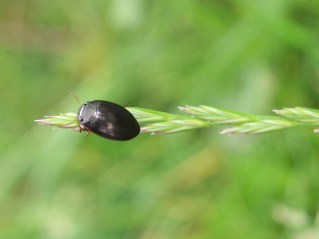
A quiet day in the VC affords ample opportunity to look around outside and observe the richness of flora and fauna that can be found close to the car park. Past forays looking deeply into the vegetation have found some unexpected insects and a few identification challenges. Last Friday, in between the thunder and lightning and torrential rain, an inspection of the long grass between the VC and Grey Owl’s monument produced an unexpected delight – a Diving Beetle (Agabus bipustulatus). It may be a common and widespread species, but one would expect to find it by water, not on a grass stem next to a car park.

Diving Beetle Agabus bipustulatusDiving Beetle Agabus bipustulatus

Longhorns in the Quarry

One of the great benefits of last winter’s cutting of large willows in the quarry is starting to be seen. The log pile that was created by the hard work of wonderful volunteers has come alive in this week’s warm sunshine, and is both a basking spot for Lizards and a prospecting site for the Wasp Beetle. This brightly coloured and attractive native longhorn beetle has been seen in good numbers all over the log stack, and hopefully making a new home for itself.

Wasp Beetle                 Clytus arietis

Lurking in the undergrowth

Whilst enjoying the glorious open spaces that are available around the Country Park, we notice various elements of the natural world whether it be clouds, birds, flowers or mud. Frequently we might notice a ladybird rampaging through the undergrowth, and become aware of the different species of ladybird that are waiting to be found. But perhaps we don’t know that these are various species of conspicuous ladybird. There are also a number of species of inconspicuous ladybirds that are seen less frequently and less easily. These tend to be very small, between 1.3mm and 3mm long, and covered in short hair rendering them dull, and either brown or black in colour. As if that combination of size and colour didn’t make finding them challenging enough, some of them live in long grass, or in ivy. It will come as no surprise that there are significantly fewer records of inconspicuous ladybirds compared to their bright and colourful relatives. If you rummage around in the long grass opposite the visitor centre there is a fair chance you will come across one of these ladybirds Rhyzobius litura, a species that is widespread around the UK but seldom noticed.

Rhyzobius litura