Back to Saxon times

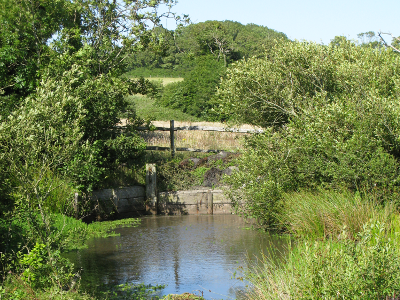
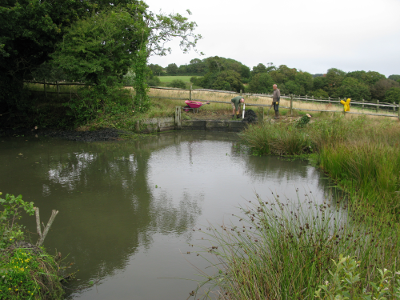
Yesterday saw a welcome return to Saxon Pond for some of us and a new part of Hastings Country Park for others.

The purpose was to cut back the vigorous willow regrowth that was starting to shade out the bankside and emergent vegetation that had established itself since we finished the initial clearance in 2012. Species now present include Great/Common Reed Mace, Soft Rush, Sea Club-rush, Water Horsetail, Bittersweet, Fleabane, Great Willowherb and Common Ragwort which has managed to establish itself on one of our log islands.

We’ll be back to carry on next week.
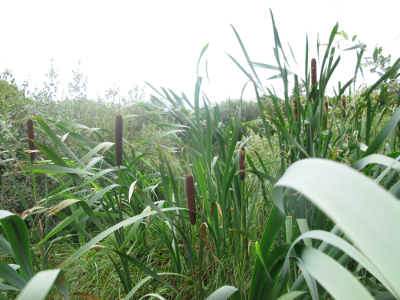
Great Reed Mace

Great Reed Mace

Theft from Hastings Country Park.

Reports are being received in the Visitor Centre of a disturbing theft from Hastings Country Park. Early indications suggest that a criminal conspiracy has been at work to deprive visitors to the Country Park of the last days of summer. At this juncture the picture is not entirely clear, but it would appear that all traces of summer have been bundled into a bag marked Swag and driven away by a man in a stripy jumper and a mask. If anyone can shed any light on this matter, please contact the relevant authorities.

Photofit picture

Photofit picture

Hastings Country Park ladybird conundrum

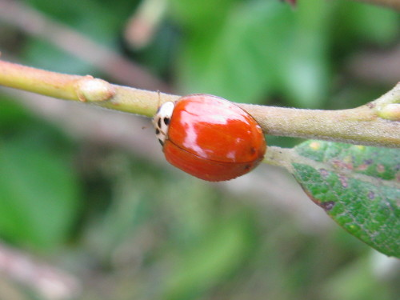
I’m very grateful to taughtus for identifying the ladybird that Stephen spotted yesterday when we were at Stock Pond which we called a “no spot ladybird”. It is in fact a Harlequin which has over 100 colour/pattern variants and my identification chart shows only 4. Hmmm, didn’t stand much of a chance did I?

The Harlequin Ladybird is a non-native species that originates from Asia. It was introduced into the USA and mainland Europe as a biological agent and made it’s way across the channel in 2004. It is a large and voracious species and is predicted to spread to most parts of the UK (source, FSC).

No_spot_2

Swarms of Migrants in Hastings Country Park.

In the past couple of weeks there have been migrants lurking in the undergrowth wherever you looked. One of the large and brightly marked hoverflies, Scaeva pyrastri, has been seen on just about every umbel of hogweed in the hedgerows around the Country Park. It is a large black and white fly with comma shaped markings and a bulging face, making it easy to identify. It is not resident in Britain but is a very frequent summer visitor, with some years seeing huge numbers of migrants. This is one such year.

Batman visits Hastings Country Park.

Among the myriad hoverflies that attend hedgerow flowers around the Country Park, some are more readily identifiable than others. There is one that has unmistakeable markings. Myathropa florea is a large and brightly coloured hoverfly whose distinctive pattern of markings on the thorax looks a bit like the Batman symbol. It is a widespread and abundant species that can be seen anywhere around the Country Park between April and November.

Image and video hosting by TinyPic

Gatekeepers.

After a slow start there has been a profusion of Gatekeeper butterflies around the Visitor Centre in the last couple of weeks. They are seen on the hedgerow next to the VC and on the field margin across the road. Such is their profusion that they frequently fly inside the VC and have to be ushered out by the volunteers.

New Visitor Centre update

This statement from Murray Davidson at Hastings Borough Council regarding the new VC has been forwarded to me by the VC staff for posting:-

‘The tenders for the new visitor centre at Hastings Country Park were higher than expected, and higher than we had budgeted for. We are now looking at different options, and these will be presented to the project board overseeing the work in October. Hastings Borough Council and its partner Groundwork Trust are committed to building a quality new visitor centre that the fantastic landscape at Hastings Country Park deserves.’

Leafcutter Bees at the Visitor Centre.

The wooden siding of the south wall of the Visitor Centre has a plethora of small knot-holes, splits and cracks, and a few of these have been adopted by Leafcutter Bees (Megachile spp.). It doesn’t take many minutes of watching before one may notice a bee flying toward the VC carrying a large piece of leaf beneath its body between its legs. The bee then squeezes its body and payload through the hole in the wooden siding. They cut leaves using their mandibles; rectangular pieces for the side walls of the cell and circular pieces for the end walls. The cells are then provisioned with a mixture of pollen and nectar for the larva to feed upon.