An unexpected benefit of the recent gorse clearance on the Firehills has been the opportunity to frame familiar views in a different way, and hence to look afresh at the Country Park and its surrounding landscapes.

An unexpected benefit of the recent gorse clearance on the Firehills has been the opportunity to frame familiar views in a different way, and hence to look afresh at the Country Park and its surrounding landscapes.

Today we re-opened a number of footpaths in Ecclesbourne Glen that have been closed due to landslips since the end of last year after having then only been open for about a month. This time we hope it will last a little longer. This was the culmination of many days work repairing culverts and steps, putting in a complete set of new steps, cutting back encroaching scrub and removing overhanging branches.
The coastal path from the East Hill to the bottom of Ecclesbourne Glen will remain closed indefinitely as it has been decided that the ground is too unstable to re-open it safely. This is shown on the map below in red and the re-opened paths in blue. The path shown in orange is also currently closed due to a collapsed culvert but will be open again once East Sussex County Council Rights of Way have replaced this with a footbridge as this is their responsibility.
To get from the East Hill to the coastal path east of Ecclesbourne Glen leave the East Hill via Rocklands Lane and head to Barley Lane car park and go through the gate closest to the parking ticket machine and go straight down to bollard 7, bear slightly right and go up to bollard 6, bear right and you are back on the coastal path.
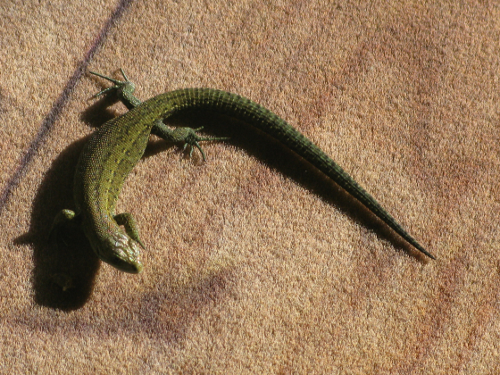
The recent reduction in opening hours of the VC has resulted in poor old Badger becoming lonely. The consequence became known today when we were introduced to Badger’s new friend; a common lizard.

Edit – This common or viparous lizard is a good example of the variation in colour they exhibit. This green colour is not uncommon and results in many people mistakenly identifying them as sand lizards. However sand lizards are larger, have a differently shaped head and the green is much more vivid.
Admin.
In a clear blue sky, a kestrel was seen for a good few hours hovering over Quarry Field. Repeated dives to catch prey appeared to go unrewarded, yet continued hovering showed that there was a lot of prey to be hunted. Unusually there was no wind today, a factor that enabled better observation of the kestrel.

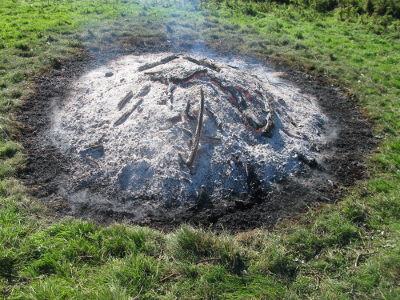
We set out as usual at about 9.30, having loaded up the trailer with the necessary tools but also with the addition of fire-beaters and large containers of water. Today made a bit of a change, for we were having a bonfire to burn last week’s arisings. Young Sam was introduced to the complexities of farm padlocks, which he mastered with ease! As we trundled across Barn Pond Field, we ‘put up’ a Snipe, the first I’ve seen in the flesh. The fire caught hold quickly under the expert hand of Martin and the four of us were soon fighting valiantly to extract branches from the prickly embrace of Blackthorn piled up last week. We had the usual break for elevenses and, when Martin suggested at 12.30 that we have a slightly later than usual lunch in order to clear the last of the piles, we readily agreed. By the time we were finished, we were all well and truly smoked! Note: During a breather, Sam and I had a short chat about the possible origins of the word ‘bonfire’ postulating that it might have derived from the French, bonfeurre. In fact, it originated in medieval times from the burning of bones or heretics!
The last couple of Thursdays we have discussed extending ourselves into Fridays as well and we have decided to give it a go. This will be on an ad hoc basis when want to finish a job off or take advantage of better weather perhaps and most likely decided at short notice. Anyone available on a Friday and wishing to join us, it would be best to contact us via email to see if we are working that day.
Next Thursday we’ll be reopening some of the footpaths on the eastern side of Ecclesbourne Glen, having carried out the necessary repairs and clearance. The coastal path on the western side however will still remain closed, probably indefinitely.
The Country Park is very generously stocked with gorse, yet it is rare that one gets to see a Gorse Shieldbug. Their colouration is well-suited to the host plant, and the structural form of the plant makes it difficult to see an insect that is very slow-moving and sits deep within the forest of spines. Today’s combination of warm sunshine and strong, cool wind seemed a good combination of elements to find them basking in the furze. A hunt around the quarry proved fruitful with fourteen Gorse Shieldbugs in view. They are now just starting to change into their winter colouration, and hence have more brown appearing in place of the usual green elytra and pronotum. Gorse Shieldbugs are not restricted to gorse and may also be found on broom and other plants of the Leguminosae, but the dominance of gorse within the Country Park makes it the primary host.

Spurred on by the tantalising glimpse of a potential Blue Shieldbug in the old quarry on Wednesday, a return visit was made today with the intention of trying to find it again. Surprisingly the bug was found, this time it was deep within a clump of Wood Sage next to the seasonal pond. The view was better this time, albeit brief since they are fast-moving insects, and it was definitely a Blue Shieldbug. This is a notable first for the Country Park.

Well we are in Rye Bay and we are creating scallops!
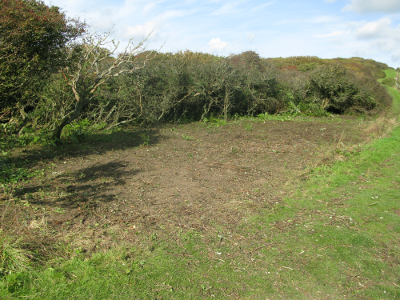
After looking like we were going to have a wet day, the rain stopped when we arrived at the job and stayed away. The scrub is mostly blackthorn with a little hawthorn sprinkled around. We have left 1 larger hawthorn and a small oak so far and 1 dead tree because standing dead wood provides important habitat just as much as fallen dead wood.
The scallop so far. The bare ground was impenetrable scrub, well, not for us of course! If you look closely you will see a couple of patches of red in the background, this is hawthorn berries. We now have a large pile of brash to deal with.
Raven and Peregrine were both seen during the day and back at the farm we saw a large bird of prey with jesses on being mobbed by corvids which we believe to be a Harris Hawk. Hopefully it will be reunited with it’s owner.
The Country Park can seem a large site when exploring its 852 acres, but sometimes there are unexpected delights to be found on the tiniest scale. Whilst searching the gorse around the quarry’s seasonal pond for Gorse Shieldbugs (which were found) a flash of metallic blue caught the eye. It was deep within the rosette of a very spiny thistle, and could only be approached through bramble, mud and water. Investigation proved worthwhile for it appeared to be a Blue Shieldbug, a notable first for the Country Park. Attempts to get a decent picture proved impossible, but there is sufficient detail to warrant further investigation: updates on the outcome will be forthcoming.