Warren Glen Walk

Sitting writing this in a thunderstorm, I’m glad we had better weather yesterday for our walk around Warren Glen. Andy, Phil, Sam, Stephen and myself met at the top of Brakey Bank at around 10:00 and had a very enjoyable walk around nearly the entire glen, taking in the flora and fauna and also visiting a few points of interest hidden away from view which are part of the history of the glen which it was remarked that it is a shame that none of this has any interpretation and is thus missed by the many visitors to the Park.

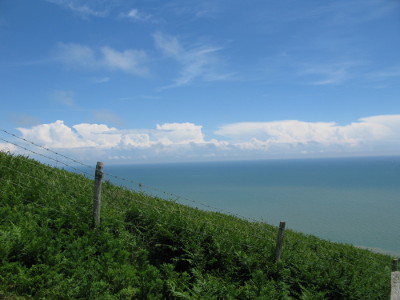
Another observation made was that due to the more open nature of this glen there is a great view from most parts. We stopped for a while at the bench below bollard 18 where we enhanced the view into the bottom of the glen. We were to have carried on and improved the view of the sea later this year at the end of the nesting season but this looks unlikely now.

Stopping again at the top of the opposite side we gazed at this remarkable cloud formation.Clouds_WG_16-06-16

Firehills Walk

Well, it’s now four weeks since we were informed of the massive reduction in our Conservation Days and still no indication of any future dates except that they may be on any day of the week. If we get any further news it will be posted here.

In an effort to maintain the social side which is all part and parcel of volunteering we have started to meet up for walks on a Thursday when people are available. We started last week with a foray into Ecclesbourne Glen, Sam, Stephen and myself and today Phil, Stephen and myself walked around the Firehills, taking in the Plantation, Hibernaculum (Phase 2 access for all trail) and the Quarry. We came across this very faded Oak Hook-tip moth on one of the areas cleared of gorse.

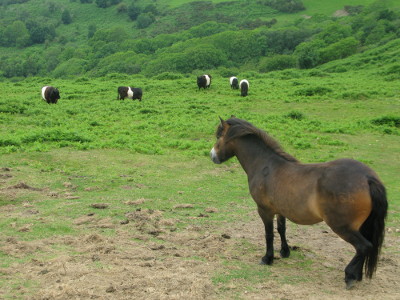
Oak_hook-tipAs we left the Hibernaculum for the Quarry we saw the Country Park’s new acquisition of five Belted Galloway cattle with an Exmoor pony looking on. One of my neighbours remembers Belted Galloways grazing Warren Glen when he worked on Fairlight Place farm as a youngster. At the moment however these cattle and the ponies seem to be favouring the two heathland compartments south of the Quarry.

Belties_Exmoor_9-6-16

Longhorns in the Quarry

One of the great benefits of last winter’s cutting of large willows in the quarry is starting to be seen. The log pile that was created by the hard work of wonderful volunteers has come alive in this week’s warm sunshine, and is both a basking spot for Lizards and a prospecting site for the Wasp Beetle. This brightly coloured and attractive native longhorn beetle has been seen in good numbers all over the log stack, and hopefully making a new home for itself.

Wasp Beetle                 Clytus arietis

Lurking in the undergrowth

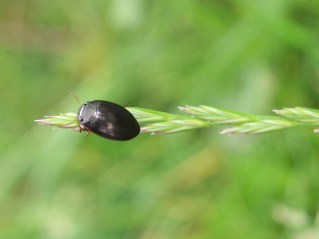
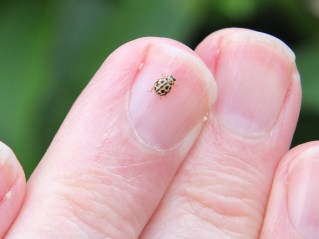
Whilst enjoying the glorious open spaces that are available around the Country Park, we notice various elements of the natural world whether it be clouds, birds, flowers or mud. Frequently we might notice a ladybird rampaging through the undergrowth, and become aware of the different species of ladybird that are waiting to be found. But perhaps we don’t know that these are various species of conspicuous ladybird. There are also a number of species of inconspicuous ladybirds that are seen less frequently and less easily. These tend to be very small, between 1.3mm and 3mm long, and covered in short hair rendering them dull, and either brown or black in colour. As if that combination of size and colour didn’t make finding them challenging enough, some of them live in long grass, or in ivy. It will come as no surprise that there are significantly fewer records of inconspicuous ladybirds compared to their bright and colourful relatives. If you rummage around in the long grass opposite the visitor centre there is a fair chance you will come across one of these ladybirds Rhyzobius litura, a species that is widespread around the UK but seldom noticed.

Rhyzobius litura

Country Park Parasites.

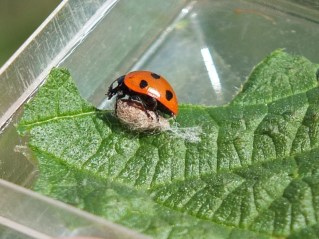
7-spot ladybirds are a regular sight everywhere around the Country Park, including the patch of nettles outside the VC. A close look at one revealed that it was unmoving and appeared to be sitting on a nest. The apparent nest is the cocoon of a parasitoid wasp Dinocampus coccinellae. The adult wasp is found in all continents except Antarctica and has been reported to parasitise 13 of the UK species of ladybird, but the majority are from the subfamily Coccinellinae, of which the species most frequently seen around the Country Park is the 7-spot ladybird. The adult wasp lays an egg within the body of the ladybird, that egg subsequently goes through three larval stages (instars) before emerging as a yellow maggot from the ladybird’s abdomen. It then spins a silken cocoon between the legs of the host, and pupates. The ladybird does not survive.

There is a new nationwide research project seeking to record the prevalence of Dinocampus coccinellae around the UK in order to determine whether it is increasing as a result of disruption to the natural balance between the 7-spot and the parasitoid wasp since the arrival of the Harlequin.

Information about this research project may be found here: https://ladybirdchallenge.co.uk/ and records of sightings are welcomed.

7-spot with Dinocampus coccinellae

A sad day for the Country Park

A group of us volunteers attended a meeting with management today thinking we were going to consolidate some points from our last meeting with regard to our working as an autonomous group. Little did we know that instead we were to be told that it had been decided that we could not operate in future without a Ranger present, despite having in reality done so for a number of years. The upshot being that with the reduction of staff it will only be possible to run 10 conservation days a year, this being in contrast to us having been doing  every Thursday and the first Sunday of every month plus some Fridays some 65+ days. This is a massive reduction and presumably the slack will have to be taken up by contractors and one can only wonder where the money is to come from when we are told that HBC has to make further cuts in spending in the coming year.

For us it will be so frustrating to see areas that we have been looking after deteriorate due lack of time if no-one else does do the work. It now remains for us to wait and see when these 10 days are going to be.

Green Flag Day

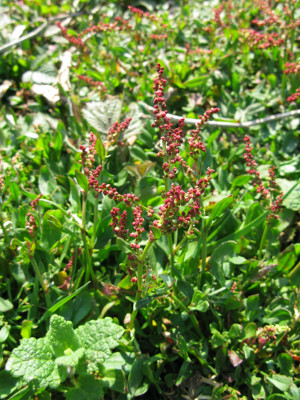
We switched days this week and worked Friday so we could meet the Green Flag Award judges. This is open to all green spaces throughout the UK and the Country Park has won it every year since it was first entered. We were in the Quarry to carry on with digging out the bramble regrowth and it was really pleasing to see a lot of sheep’s sorrel now in flower on the areas that we have cleared.

s_sorrel

There is also plenty of wood sage and rosebay willowherb taking advantage of the light now available with the scrub gone. We hope that there will be a botany survey this year to highlight the increase in diversity of plant species.

Another ladybird found today was a seven spot.7_spot_quarry_6-5-16

Sunshine at last…

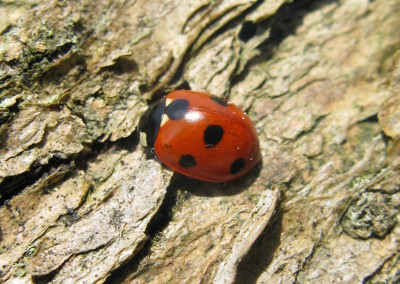
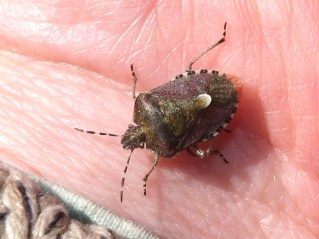
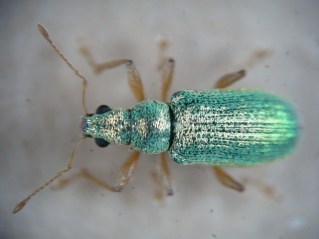
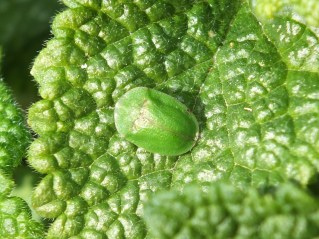
It seemed appropriate to mark the relenting of that persistent cold wind with a stroll in the quarry to see if any insects would appear in the very welcome sunshine. Winter clearance work by the Volunteers has created perfect new habitat on some of the banks in the quarry and enriched this site. A first glance at the unfurling leaves on willow regrowth near to the exposed rock faces saw a Cream-spot Ladybird and a brilliant metallic green/gold Weevil (Polydrusus pterygomalis). Turning into the open quarry a Small Copper butterfly was flitting around the Wood Sage and warming in the sunshine. A closer look at the Wood Sage saw a Green Tortoise Beetle and a Sloe Bug (or Hairy Shieldbug if you prefer). All of these beautiful insects were in habitat that has been created by the diligent work of the Volunteers, to whom we say thank you.

Cream-spotSloe BugPolydrusus pterygomalisGreen Tortoise Beetle  Cassida viridis

Helipad wildlife.

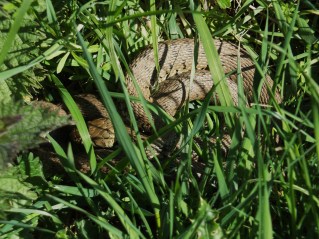
Early morning sunshine at the helipad found a beautiful grass snake basking in the longer grass at the Fairlight Road side of the site. Further inspection of the area found eleven 7-spot ladybirds, one of which was parasitised with a wasp (Dinocampus coccinellae). Nearby were two 16-spot ladybirds.

6pvvat2v8k1gj9sazux

North’s Seat (part three)

Further attempts to identify the plentiful small invertebrate wildlife of North’s Seat (and keep out of the bitterly cold wind) have found a Birch Shieldbug Elasmostethus interstinctus, a Cream-spot Ladybird Calvia quattuordecimguttata,  and another two Weevils – a female Polydrusus cervinus and a Polydrusus tereticollis.

Birch ShieldbugPolydrusus cervinus? femaleCream-spotPolydrusus tereticollis