Mind where you tread (continued)

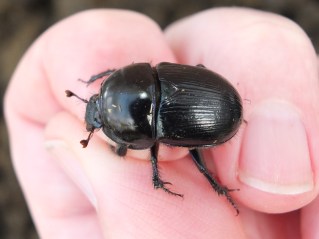
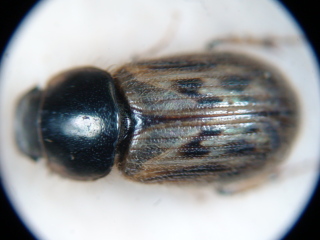
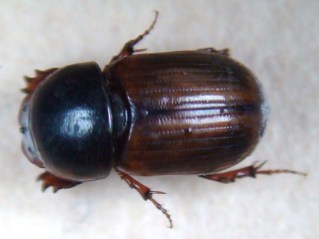
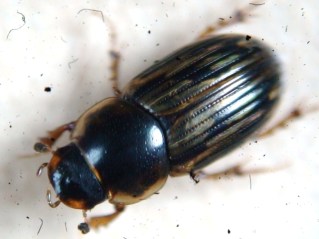
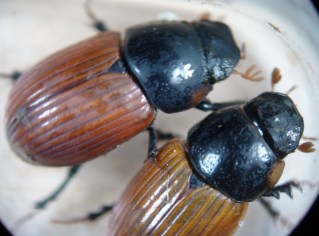
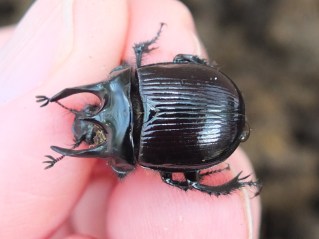
Another dung beetling session in the grazed areas at the head of Warren Glen found seven species of dung beetle, of which three were new to the CP. This bring the total to fifteen species of dung beetle thus far. The new ones were:

Aphodius (Nimbus) contaminatus (upper picture),

Aphodius (Planolinus) borealis (middle picture),

Aphodius (Volinus) sticticus (lower picture).

A.sticticus has been found in Guestling Woods and Battle Great Wood, but A.contaminatus and A.borealis would seem to be new to this area.

Aphodius contaminatusAphodius borealisAphodius sticticus

Conservation Day 18th September

Well, yesterday was the only day for the Country Park in the list of six that HBC have been promoting recently on Facebook. There was just two of us that attended, hardly surprising from our existing group considering the 4 month gap and the lack of response by HBC to email enquiries that I have been told about but the flood of new volunteers that we were promised from using social media to promote volunteering has not materialised. I am told that currently there are no further dates in the pipeline for any of the sites in the Borough and given that I believe three of the days were cancelled due to various reasons and a low turn out for most of the others, I would not be surprised if no more dates were forthcoming. From a management point of view it must be difficult to justify tying up a ranger for the best part of a day for such small numbers of volunteers.

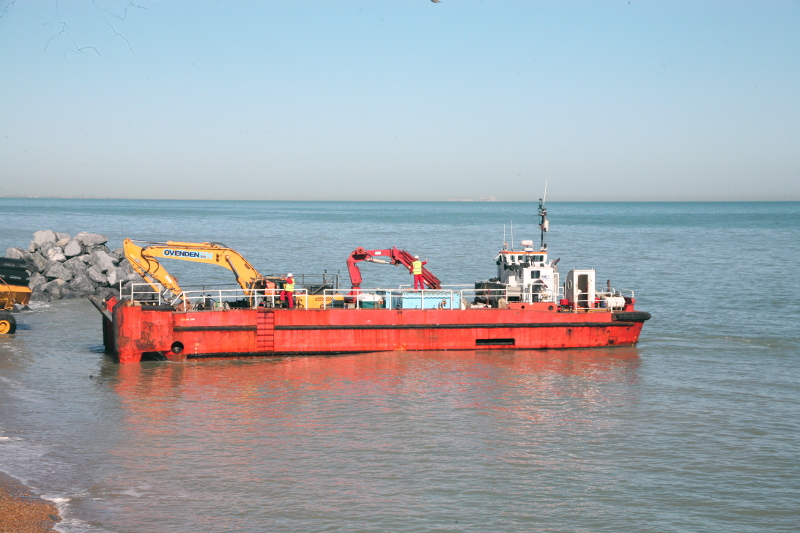
Ovendens storm the beach!

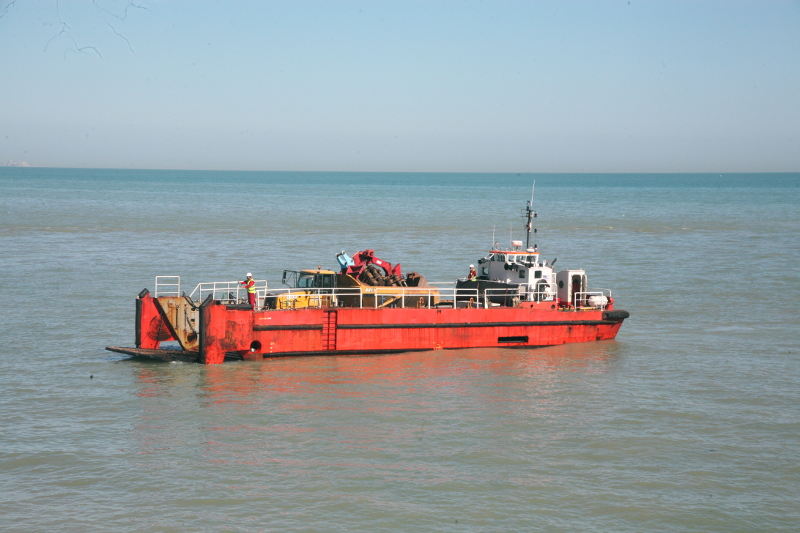
The final stage of the coastal protection berm at Fairlight Cove started recently. A large barge the Stema Barge II is moored offshore that is stated to be capable of carrying 21,000 tonnes of Larvikite an igneous rock similar to granite that comes from Norway.

Having checked the tides I made my way up to the cliff path east of the village to watch the smaller barge the Charlie Rock towed by the Afon Goch come in and was surprised to see some sort of landing craft leaving the beach having dropped off a dump truck. I had assumed that the heavy plant that was on the beach at Pett Level would be tracked round at low tide, so I rushed round to Cliff Way to have a better view when it returned with it’s next load.

Here comes dump truck no 2

The landing craft is called Severn Sins from the port of Bideford and a little research has revealed that it is a LCU (landing craft utility) Mk9 which were carried by the Amphibious Assault Vessels (4 each) HMS Fearless and HMS Intrepid (not the Invincible as previously stated here, many thanks to Pete who served on the Fearless for correcting that) that saw action in the Falklands.

The last load. Some of the freshly unloaded rock can be seen just left of the excavator boom

It seems that the Stema Barge II will be empty tomorrow. It will be interesting to see how many loads it takes to complete the works.

Short video of the Charlie Rock barge unloading, shame about the sound, it was windy!

Mind where you tread.

It is now two years since the Exmoor ponies arrived as residents of the CP, to be joined by the White Parks and then the Belted Galloways. It is easy to see the effect that their residency and grazing is having in various areas above Warren Glen, but a less visible benefit is doing remarkably well. The output from their grazing has provided a welcome opportunity for Dung Beetles to enrich the insect fauna of the CP. Initial investigations have identified ten species, which in their turn provide a great amount of food for bats and birds and also work the soil and enrich it as manure is buried. Species found thus far are: Aphodius fimetarius, Aphodius fossor, Aphodius haemorrhoidalis, Aphodius rufipes, Aphodius rufus, Cercyon haemorrhoidalis, Cercyon pygmaeus, Hister unicolor, Onthophagus medius, Onthophagus similis, Sphaeridium scarabaeoides – alas no common names as their study is not exactly a mainstream pastime. Reference to the National Biodiversity Network database would suggest that most of these species are new to the CP and several seem to be new to the county.

Aphodius fimetariusOnthophagus medius

What a load of old Dinosaurs

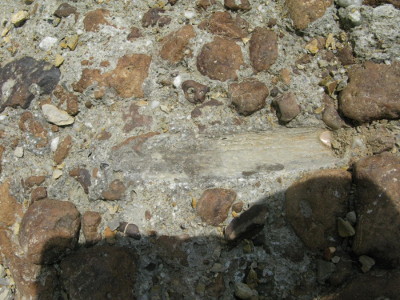
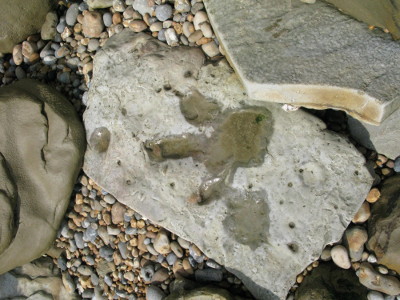
Last Thursday we went a little “off piste” and paid a visit to Pett Level. Andy who has been studying such things kindly offered to take us on a fossil hunt at Cliff End. he introduced us to the bone bed which looks more like concrete than a place where fossils may be lurking.

bone_bedSan spotted this which we think is a dinosaur footprint that has been well worn by the tides.

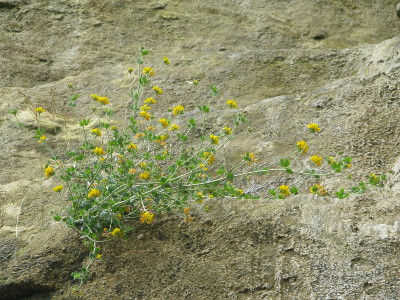
dino_F_POff topic, but I had to take a photo of this Greater Birds-foot Trefoil just growing out of the cliff.Greater_BFT_28-07-16We finished off with a wander round Toot Rock, an interesting piece of second world war history.

Rutpela or Strangalia?

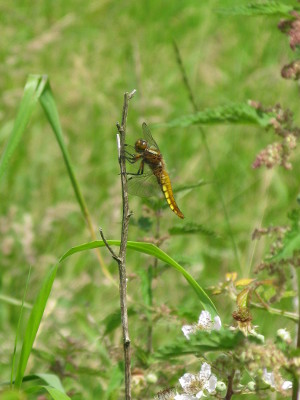
We were blessed with excellent weather today for our Fairlight Glen walk. The route started round the top where we stopped to admire the tenacity of the beech tree literally growing out of the rock and the Ordnance Survey bench mark in the rock, a bit of “official graffiti” along with the inevitable names. We then took the ghyll stream path up to the dripping well taking in the unique vegetation on the way, then it was up the steps and down again to take the path through Longshore Wood and up Smugglers Steps. Thence on to Barn Pond and in the hedge on the way, Sam our invertebrate spotter found us this Longhorn Beetle which my book has as Strangalia maculata but it seems to have changed to Rutpela maculata, hence the title and also an immature male Broad Bodied Chaser.

hquin_longhorn im_m_bbc

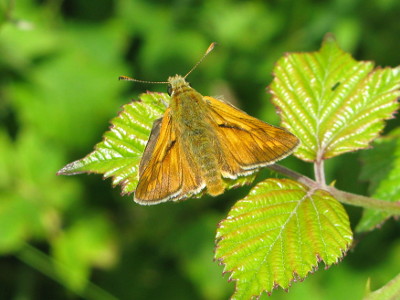
At Barn Pond we were treated to Broad Bodied Chasers, Emperor Dragonflies and Linnet taking advantage of the Parrot’s Feather to have a drink in the middle of the pond. We also saw a few grass vetchling in flower where I saw many last year. Still not a great day for butterflies only Meadow Brown and Small/Essex Skipper.

Skipper

Windmills and Cricket

Yesterday in spite of the weather three of us met up for a walk around the Helipad and North’s Seat and in fact the rain held off the whole time, just! Starting at the roundel with the view not what it can be on a good day, Phil said that he could remember the wooden viewing platform that was once there which burnt down as did the Windmill in 1869. Walking round we came to the reservoir the site of the most recent fire. North’s Seat is so called because of the seat put on the site of the windmill by Marianne North best known for her botanical paintings of which there is a gallery at Kew Gardens. The seat was to commemorate her late father Frederick North MP.

Moving toward the Helipad  (not sure when it got that name or where one would land a helicopter there now) we checked out the hedge that we planted last November and were pleased to see almost 100% survival of the whips. This hedge is pretty much on the line of the of the two fields on the 1839 tithe map, the one that the footpath across it being Down Field and the other was called Cricketing Field, however there is no evidence of cricket ever having played there. On a post at the Helipad entrance Sam spotted this Ichneumon, Rhyssa peruasoria, a parasite whose larvae feed on the larvae of the Horntail, a sawfly. It has drilled into the post in the photo and is ovipositing.

Rhyssa_pWalking round we noted there is still evidence of the RAF domestic site of WWII  and the early Cold War. Here we saw Goldfinch and plenty of Bristly Oxtongue and Spear Thistle.

We also took in the two heather patches and pondered such mysteries as why plastic doorstops have been fitted to kissing gates and the history behind the British Anzani Iron Horse.

A number of Meadow Brown were in evidence along the walk and walking home I saw two raven fly off Brakey Bank field which was freshly topped, rare to see them that close and be able appreciate what a massive wingspan they have.
Muddy footpaths in June!

Outside today you could call it flaming June but the recent rain has made some very unseasonal conditions. Our group walk yesterday was cancelled as we would have got soaked just getting to the meeting point.

It cleared up and I decided to go out in the afternoon. Saw my first Meadow Brown of the year on the verge in Fyrs Way before I got to the Country Park. I had only planned to go as far as Warren Glen but arriving at the bottom of Lovers Seat steps carried on through Fairlight Glen as it looked like the weather would hold and I had not yet seen the new bridge in Ecclesbourne Glen. When I got as far as Ecclesbourne Meadow I felt a few spots of rain and I realised that I was going to get wet anyway but it was worth it to see a small flock of Goldfinch in Ecclesbourne Meadow.

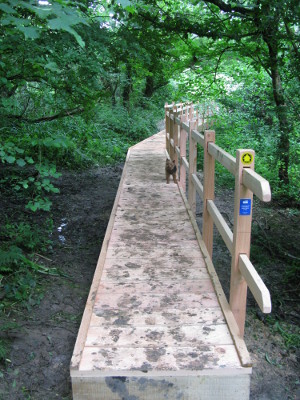
The path down into the glen afforded a little shelter and at the bottom I found what must be the longest footbridge for miles. I counted 26 paces. The old collapsed culvert has been completely removed allowing the stream to flow unimpeded again.

new_bridgeStanding on the bridge there is a lovely smell of freshly sawn Douglas Fir. Leaving the glen by the track up past the reservoir I came across the ESCC team who had just finished the bridge having problems extricating themselves in the very wet and slippery conditions. I spoke to them briefly and they told me that they were going to leave the other two bridges they have still to do for a few weeks to let it dry up. These are harder to access than the one in the photo being down the path where repaired the revetments last year.

It would seem that because of the very wet winter that we had it has not taken much rain to make some footpaths quite muddy again.

Antediluvian?

A quiet day in the VC affords ample opportunity to look around outside and observe the richness of flora and fauna that can be found close to the car park. Past forays looking deeply into the vegetation have found some unexpected insects and a few identification challenges. Last Friday, in between the thunder and lightning and torrential rain, an inspection of the long grass between the VC and Grey Owl’s monument produced an unexpected delight – a Diving Beetle (Agabus bipustulatus). It may be a common and widespread species, but one would expect to find it by water, not on a grass stem next to a car park.

Diving Beetle Agabus bipustulatusDiving Beetle Agabus bipustulatus