Unexpected Quarry.

The rare pleasure of a morning with sunshine and no wind while shaded areas of the Country Park were still rimmed with frost provided the unexpected discovery of a very late season Gorse Shieldbug in the quarry. Sightings of shieldbugs in late November are highly unlikely. The air temperature had risen to (approximately) 4 degrees and the bug was tucked well into the gorse yet it had sufficient energy to sidle away from the camera’s attention.


Sunday in the Quarry.

The cold easterly winds that are sweeping much of the Country Park are keeping out of the quarry allowing warmth to build up on the south facing aspects. This has enabled a leisurely Sunday afternoon stroll to be brightened by several Small Copper butterflies, a couple of Common Darter dragonflies, plenty of Gorse Shieldbugs, and a lone Devil’s Coach Horse.


Picture Frame.

An unexpected benefit of the recent gorse clearance on the Firehills has been the opportunity to frame familiar views in a different way, and hence to look afresh at the Country Park and its surrounding landscapes.

Out-of-Hours at the VC.

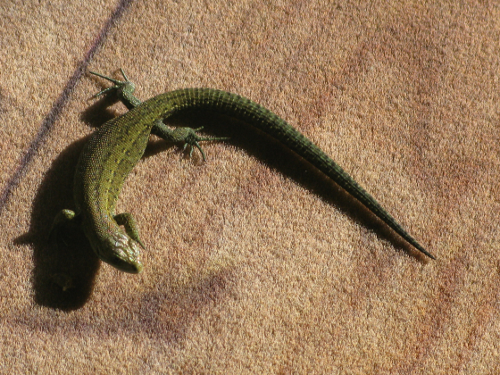
The recent reduction in opening hours of the VC has resulted in poor old Badger becoming lonely. The consequence became known today when we were introduced to Badger’s new friend; a common lizard.

Edit – This common or viparous lizard is a good example of the variation in colour they exhibit. This green colour is not uncommon and results in many people mistakenly identifying them as sand lizards. However sand lizards are larger, have a differently shaped head and the green is much more vivid.

Admin.

The Windhover.

In a clear blue sky, a kestrel was seen for a good few hours hovering over Quarry Field. Repeated dives to catch prey appeared to go unrewarded, yet continued hovering showed that there was a lot of prey to be hunted. Unusually there was no wind today, a factor that enabled better observation of the kestrel.


Gorse Hunting.

The Country Park is very generously stocked with gorse, yet it is rare that one gets to see a Gorse Shieldbug. Their colouration is well-suited to the host plant, and the structural form of the plant makes it difficult to see an insect that is very slow-moving and sits deep within the forest of spines. Today’s combination of warm sunshine and strong, cool wind seemed a good combination of elements to find them basking in the furze. A hunt around the quarry proved fruitful with fourteen Gorse Shieldbugs in view. They are now just starting to change into their winter colouration, and hence have more brown appearing in place of the usual green elytra and pronotum. Gorse Shieldbugs are not restricted to gorse and may also be found on broom and other plants of the Leguminosae, but the dominance of gorse within the Country Park makes it the primary host.


Confirmation of a New Record for the Country Park.

Spurred on by the tantalising glimpse of a potential Blue Shieldbug in the old quarry on Wednesday, a return visit was made today with the intention of trying to find it again. Surprisingly the bug was found, this time it was deep within a clump of Wood Sage next to the seasonal pond. The view was better this time, albeit brief since they are fast-moving insects, and it was definitely a Blue Shieldbug. This is a notable first for the Country Park.


A Blue Flash.

The Country Park can seem a large site when exploring its 852 acres, but sometimes there are unexpected delights to be found on the tiniest scale. Whilst searching the gorse around the quarry’s seasonal pond for Gorse Shieldbugs (which were found) a flash of metallic blue caught the eye. It was deep within the rosette of a very spiny thistle, and could only be approached through bramble, mud and water. Investigation proved worthwhile for it appeared to be a Blue Shieldbug, a notable first for the Country Park. Attempts to get a decent picture proved impossible, but there is sufficient detail to warrant further investigation: updates on the outcome will be forthcoming.


Another First for the Country Park.

The huge quantities of large migrant hoverflies that were so evident on the hogweed when it was in flower were of the species Scaeva pyrastri. Although a migrant from Europe, large numbers may be expected in the Country Park each year. There is another hoverfly of the same genus that is equally large and conspicuous, yet it had never been recorded in the Country Park until this month. A good number of Scaeva selenitica have been observed on the Bristly Ox-tongue flowers outside the visitor centre in the moments when the sun has graced us with its presence.


Odd Couple outside the Visitor Centre.

The yellow flowers of Bristly Ox-tongue outside the Visitor Centre are being frequented by two species of hoverfly of the same genus. One is common hereabouts, the other has not been recorded here before. Both are recognisable by the sharpness of the elongate black wing stigma. Dasysyrphus albostriatus is frequently seen and is recognisable by the white thoracic stripes that inform the name. Dasysyrphus tricinctus is noticeably darker and has a very uneven yellow stripe configuration on the abdomen.