Out-of-Hours at the VC.

The recent reduction in opening hours of the VC has resulted in poor old Badger becoming lonely. The consequence became known today when we were introduced to Badger’s new friend; a common lizard.

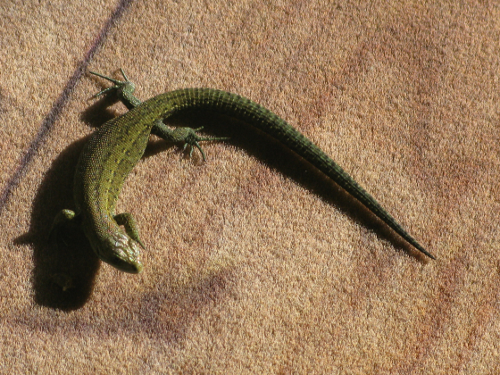
Edit – This common or viparous lizard is a good example of the variation in colour they exhibit. This green colour is not uncommon and results in many people mistakenly identifying them as sand lizards. However sand lizards are larger, have a differently shaped head and the green is much more vivid.

Admin.

Gorse Hunting.

The Country Park is very generously stocked with gorse, yet it is rare that one gets to see a Gorse Shieldbug. Their colouration is well-suited to the host plant, and the structural form of the plant makes it difficult to see an insect that is very slow-moving and sits deep within the forest of spines. Today’s combination of warm sunshine and strong, cool wind seemed a good combination of elements to find them basking in the furze. A hunt around the quarry proved fruitful with fourteen Gorse Shieldbugs in view. They are now just starting to change into their winter colouration, and hence have more brown appearing in place of the usual green elytra and pronotum. Gorse Shieldbugs are not restricted to gorse and may also be found on broom and other plants of the Leguminosae, but the dominance of gorse within the Country Park makes it the primary host.


Confirmation of a New Record for the Country Park.

Spurred on by the tantalising glimpse of a potential Blue Shieldbug in the old quarry on Wednesday, a return visit was made today with the intention of trying to find it again. Surprisingly the bug was found, this time it was deep within a clump of Wood Sage next to the seasonal pond. The view was better this time, albeit brief since they are fast-moving insects, and it was definitely a Blue Shieldbug. This is a notable first for the Country Park.


A Blue Flash.

The Country Park can seem a large site when exploring its 852 acres, but sometimes there are unexpected delights to be found on the tiniest scale. Whilst searching the gorse around the quarry’s seasonal pond for Gorse Shieldbugs (which were found) a flash of metallic blue caught the eye. It was deep within the rosette of a very spiny thistle, and could only be approached through bramble, mud and water. Investigation proved worthwhile for it appeared to be a Blue Shieldbug, a notable first for the Country Park. Attempts to get a decent picture proved impossible, but there is sufficient detail to warrant further investigation: updates on the outcome will be forthcoming.


Water Crowfoot identification isn’t easy!

Some flowers and floating leaves have appeared on the  Water Crowfoot at Saxon Pond making my original identification wrong. It is now probably Brackish Water Crowfoot but may be Pond Water Crowfoot and without a seed I cannot be sure even after trying 3 different books.

The water level has risen a lot after this weeks rain, so we finished the job just in time. Still plenty of dragonflies, swallows and house martins today.

Walking home I saw a flock of around 50 goldfinches along the “Bon Jovi” path many of which were juveniles and a male peregrine and a raven having a ding dong above the Quarry.

Odd Couple outside the Visitor Centre.

The yellow flowers of Bristly Ox-tongue outside the Visitor Centre are being frequented by two species of hoverfly of the same genus. One is common hereabouts, the other has not been recorded here before. Both are recognisable by the sharpness of the elongate black wing stigma. Dasysyrphus albostriatus is frequently seen and is recognisable by the white thoracic stripes that inform the name. Dasysyrphus tricinctus is noticeably darker and has a very uneven yellow stripe configuration on the abdomen.


Volunteers treated to aerobatic display

Yesterday we carried on cutting back the water’s edge scrub at Saxon Pond and saw an amazing display of Swallows and House Martins swooping down and skimming across the surface of the pond, feeding. Ruddy Darters and Blue-tailed Damselflies were again present too.

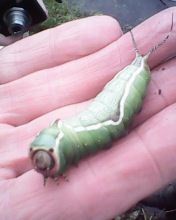
We also came across this caterpillar, which despite it’s size is not a hawkmoth as first thought but a Puss Moth.

Puss Moth caterpillar

Puss Moth caterpillar

The foodplants of these caterpillars is Aspen and Willow, particularly low regrowth and is camouflaged to suit.

Puss_Moth2

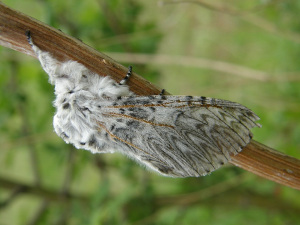
Puss Moth

The rain held off ’till we were ready to pack up and we’ll be doing another day there to finish off.

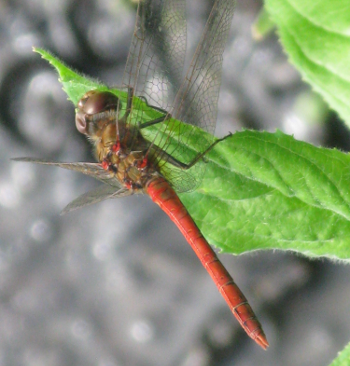
Ruddy Darter on Great Willowherb.

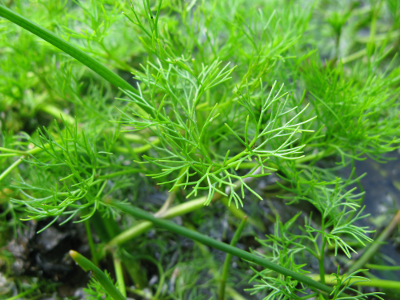
I made another visit to Saxon Pond yesterday to attempt to identify a plant that had so far eluded me. I am now fairly certain that it is Thread-leaved Water-crowfoot .

t-l_water_crowfoot

The sunshine treated me to a wonderful display of darter dragonflies (15+), which this photo enabled me to identify as Ruddy Darters.Ruddy_darterI also saw Emperor dragonflies, Blue-tailed damselflies plus Small Tortoiseshell and Holly Blue butterflies.

Hoping for some sunshine on Thursday, so the rest of the group might see these amazing sights too.

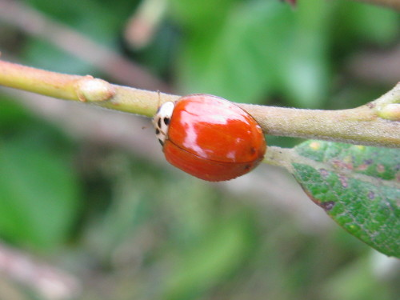
Hastings Country Park ladybird conundrum

I’m very grateful to taughtus for identifying the ladybird that Stephen spotted yesterday when we were at Stock Pond which we called a “no spot ladybird”. It is in fact a Harlequin which has over 100 colour/pattern variants and my identification chart shows only 4. Hmmm, didn’t stand much of a chance did I?

The Harlequin Ladybird is a non-native species that originates from Asia. It was introduced into the USA and mainland Europe as a biological agent and made it’s way across the channel in 2004. It is a large and voracious species and is predicted to spread to most parts of the UK (source, FSC).

No_spot_2